
Biewer Forest Management
A division of Biewer Lumber, we’ve been family-owned for over 50 years, operating state-of-the-art sawmills across Michigan, Wisconsin, and Mississippi. Our integrated approach—from forest to finished lumber—ensures quality, sustainability, and value at every step. Join the growing number of landowners who trust Biewer to manage their forests with care and expertise.
About Biewer Forest Management
Biewer Forest Management, a part of the Biewer Lumber family of companies, began in 1983 with our first sawmill in McBain, Michigan. We work with woodland owners to help them achieve their forest management goals. All landowners have unique and diverse goals for their property. Whether it is wildlife management, timber production, or recreation, Biewer has a team of qualified Foresters with over 65 years of combined experience to assist landowners in achieving their best forest.
Our Tailored Approach
Biewer provides complete management services including writing land owners individual management plans, timber marking, identifying cutting boundaries, and managing the entire process from sale set-up to the harvesting of timber. Biewer’s foresters participate in many forestry, landowner, and industry groups and associations so we can stay up to date on the changing landscape of forestry practices and governance.
Shaping a Sustainable Future with Responsible Forestry
Our “From Forest to Framework™” approach ensures that every tree we harvest contributes to a healthier ecosystem-selectively thinning forests to improve growth, resilience, and biodiversity. As part of Biewer’s commitment to sustainable forestry, we require that log suppliers complete core education programs that include training in water quality, wildlife management, forest silviculture practices, equipment maintenance, soil conservation, and harvesting techniques.
About Our Land Owner Program
Our Biewer Tree Farm Forester will work together as a partner with you, the landowner, to listen to your concerns, goals, and objectives. Then, if needed, we will write a management plan for your forest, keeping your goals as the target of the plan and recommending management techniques available to maximize your desired end results.
The management plan is the foundation for future decisions regarding the plantation and is to be used as a flexible guideline. Of course, the landowner may change the objectives at any time, and the plan will be adjusted accordingly.
This forest management plan can and will be used when applying for federal and state cost share monies or for application into the state tax program.
Forest Management Plan
- A description of timber stand management, both for red pine and any other species which may be present.
- A forest cover type map and/or an aerial photograph.
- An inventory of present conditions, including items such as age, volume per acre, site index, basal area, and total acreage.
- Growth and yield projections using current stand information.
- A management prescription describing future thinnings and harvests, including stocking charts for present and target densities.
- A summary of current stand conditions, including current stand health and vigor, as well as any current insect and disease problems.
Periodic Inspections
Since the management plan is written to be flexible and to accommodate both the landowner and nature, it is important that we revisit and inspect the timber stand at periodic intervals, at no cost to the landowner. At your request, we will also be available to address any immediate concerns such as fire, wind, insect, or disease problems.
Landowner Organizations & Associations
The number of landowners actively managing their forests is growing every year. By becoming involved in landowner organizations and associations, you can receive help and assist others in their land management.
Timber Sale Preparation & Marketing
As a result of your timber management, you will grow marketable forest products which need to be harvested. Your Biewer Tree Farm Forester will assist you in the proper marking of your timber. Once the timber evaluation is complete, a recommendation will be made concerning your available markets.
Right of First Refusal on Timber Harvests
In exchange for providing the services outlined above, if the timber to be harvested is of the type and size which we can utilize, Biewer Lumber™ asks for the opportunity to offer a purchase price for the stumpage to be harvested. In the event that the landowner receives additional offers to purchase their timber, we reserve the right to make a final bid to match or exceed those offers.
Land Owner Program FAQs
We work with you, not just for you. Whether you’re a private landowner, a family with generational property, or a business managing large tracts, we listen to your goals and customize our services to meet them. Learn more about our Landowner program today.
How do I know if my trees are ready to be harvested?
Typically, red pine trees need to be on average 35-40 years old before they are ready for a first thinning. The best way to determine whether trees are ready is to have a Forester meet with you to look over your property and make recommendations.
Does Biewer write Forest Management plans?
Our Foresters do write management plans for landowners that we have timber sale contracts with.
How many years do you typically wait between thinnings?
After the first row thinning, there is typically about 8-10 years before another thinning is due. Red pine is usually thinned 3-4 times before it is removed for replanting.
What species do you accept at McBain?
We purchase red pine, white pine, Austrian, spruce, and jack pine.
How Do We Support Responsible Forest Management?
- Broadening the practice of sustainable forestry
- Ensuring prompt reforestation
- Protecting water quality
- Enhancing wildlife habitat
- Minimizing the visual impact of harvesting
- Protecting special sites
- Contributing to biodiversity
- Continuing improvements in wood utilization
- Continuing the prudent use of forest chemicals to ensure forest and environmental health
- Encouraging sound forest management principles
Why Pine?
Red Pine
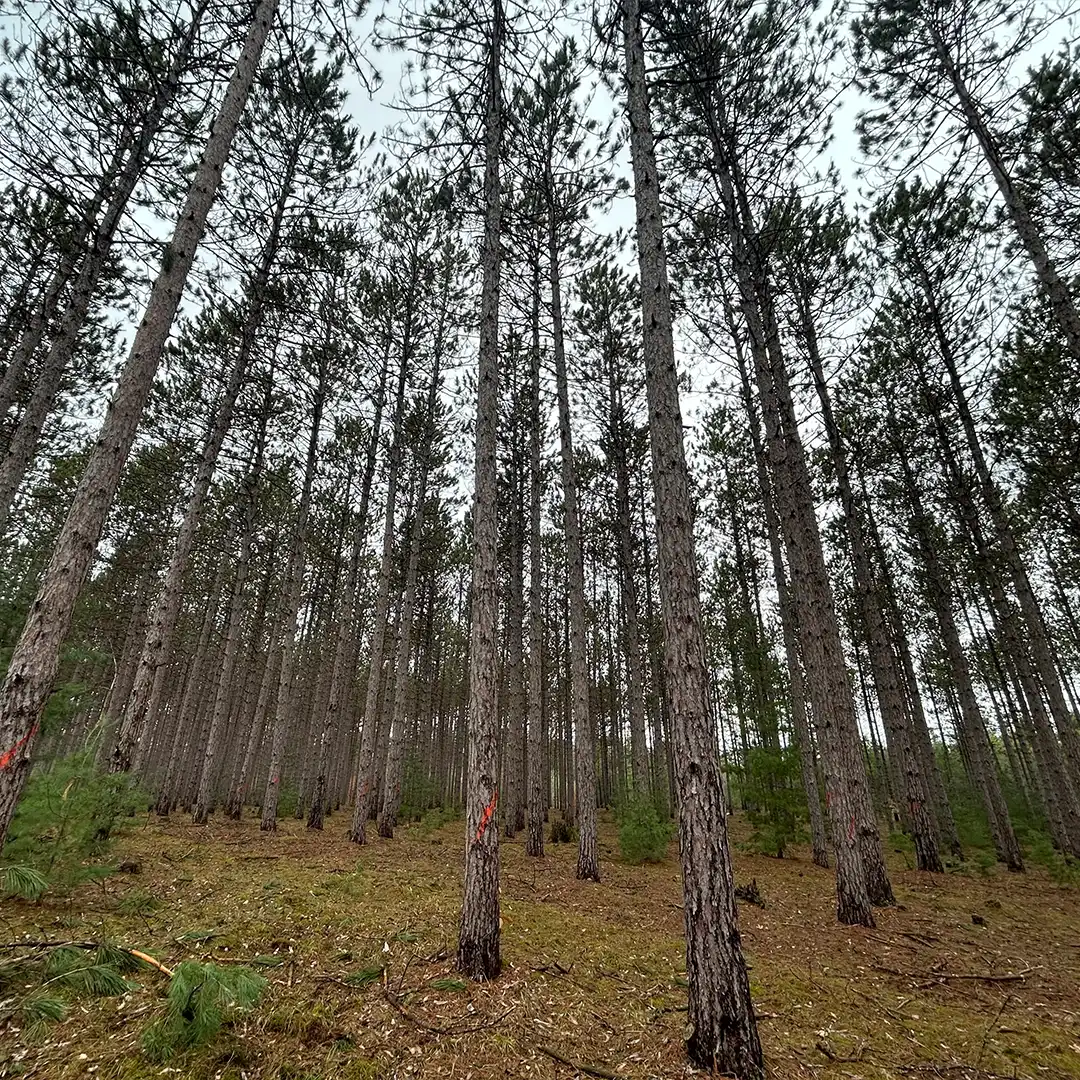
Pinus Resinosa, commonly known as Red (Norway) Pine is the only softwood species naturally found in the northern Great Lakes region that readily accepts treatment. Red Pine trees are evergreen trees characterized by tall, straight growth. When growing under natural conditions, the red pine reaches a height of 90 to 100 feet and a diameter of 30 to 40 inches, with a tall, straight, clean trunk and an open, rounded picturesque crown. The tree gets its name from the bright orange-colored or reddish bark, which divides into large plates as the tree matures.
Biewer specializes in Red Pine because of its restricted wane with small, tight knots and it is graded for optimum appearance. The strength properties of Red Pine lend themselves well for use in construction applications, such as girders, beams, joists, studs and trusses. Red Pine also remains fairly light after treatment, which helps to minimize freight cost.
Yellow Pine
Forestland in Mississippi currently occupies 19.51 million acres; 5.6 million acres are in pine forests. Loblolly Pine is one of the most important commercial softwood species in the U.S. South and the most widely planted southern pine with an average growth rate in our area of approximately 10% per year. Well managed planted pines have substantially lower mortality rates and higher rates of net annual growth. In Central Mississippi, pine plantations average nearly 128 cubic feet of wood growth per acre per year. The product availability, quality, and machinability makes SYP an ideal choice for being used in building products.
SPF
While Biewer predominantly produces lumber from pine, Biewer also produces lumber from spruce, and fir. Collectively these three species together are commonly referred to as SPF (Spruce, Pine, Fir). Lumber labeled as SPFs could contain a combination of Spruces, Pines, and Firs, produced from logs harvested in the USA. These species are ideal for timber harvesting due to their rapid growth rates, making them a more sustainable resource. SPF’s straight grain and strength makes it a good candidate for construction and framing.
SPF wood has a high strength-to-weight ratio, and small, sound-tight knots. SPF also takes paint easily, holds nails effectively, and meets building code requirements for fire safety, strength, and sound transmission.
Michigan has over 20 million acres of forest land, an increase since the inventory by the Forest Service in the 1980s. Of this 20 million acres, spruce/fir is the most prevalent softwood group. Wisconsin has an additional 17 million acres of forestland. Both Michigan and Wisconsin have seen growth in forestland since the late 19th and 20th centuries. As forest management and sustainability efforts persist, SPF lumber remains a cornerstone of the timber industry, blending practicality with environmental resilience.
Why We Are Green
As a company dedicated to sustainable practices for more than 20 years, we recognized early on that business and environmental stewardship can— and should— go hand-in-hand.
We process over 4.2 million tons of logs each year in order to meet the high demand for our lumber products. How can that be “green”? The answer is that we responsibly manage the entire lumber process, from tree farming to processing, to ensure a sustainable future.
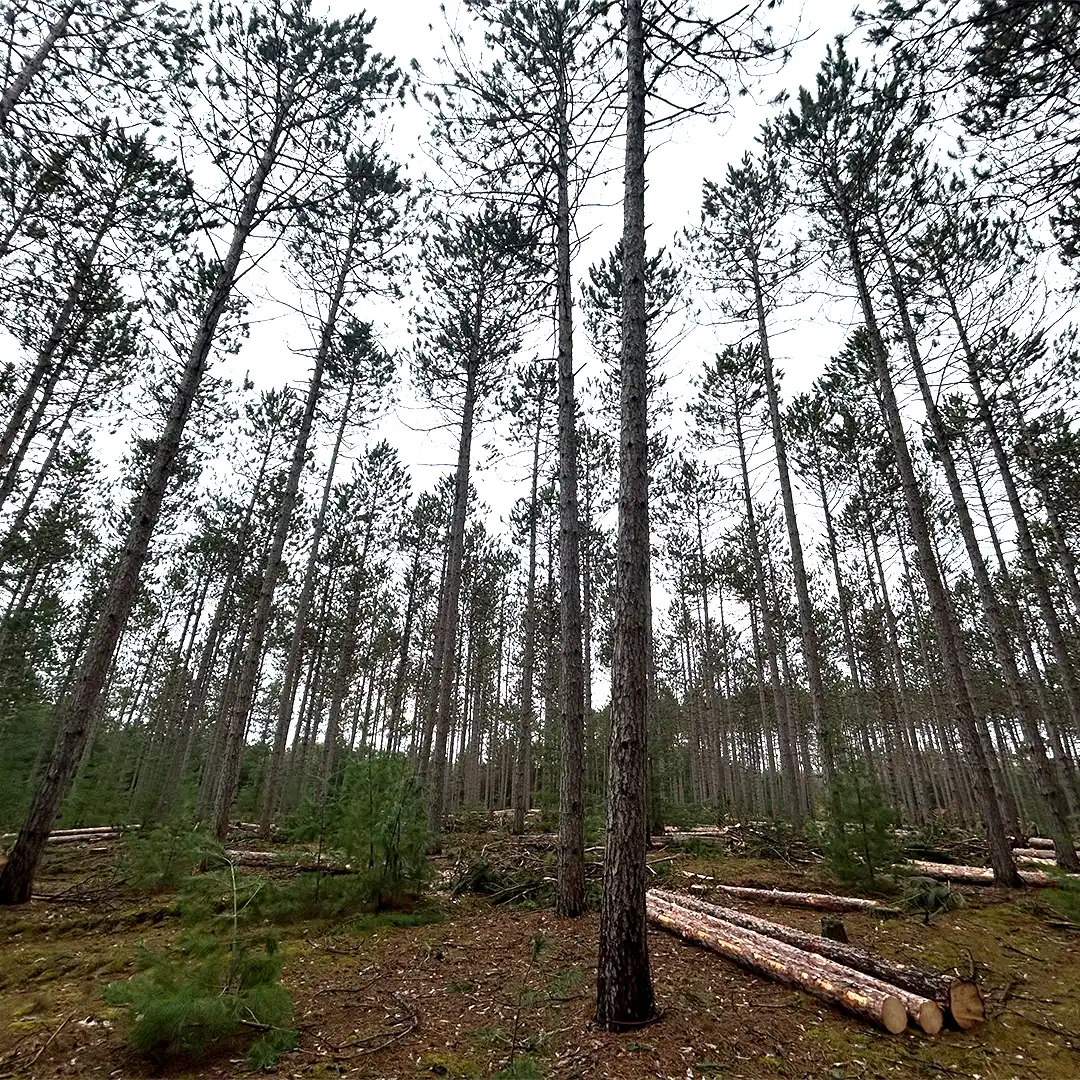
Our approach, which we call “From Forest to Framework™” begins with the trees themselves. Biewer systematically selects the trees to be harvested, rather than clear-cutting. This process, called thinning, improves the growth rate, size, and health of the remaining trees. Overcrowded trees are stressed trees, competing with each other for nutrients, water, and sunlight. Thinned trees better withstand drought, insect infestation, and extreme temperatures. This responsible harvesting allows the remaining trees to flourish.
Harvested trees arrive at one of Biewer’s state-of-the-art sawmills, where they are debarked. The bark is then either used as fuel for our on-site boilers, supplying heat to our kilns, or sold as landscape mulch. Each debarked log is scanned and an optimizing computer determines the best yield for each log. This efficient process results in very little waste or unsaleable boards.
All lumber processed in our sawmills is heat-treated to eliminate transferable fungus and pests, thus protecting living trees. After it is cut, each board is surfaced with a planer. All of our finished products are stamped with a heat-treated Association stamp.
Processing lumber produces many by-products. Paper mills use the wood chips in the paper-making process, farmers use the shavings as animal bedding, and the sawdust is sold as wood flour or used on-site at Biewer as fuel to heat the boilers. Nothing is wasted.
Full-time foresters at each sawmill oversee the processes, ensuring our high standards are upheld while administering Biewer’s Private Landowner Assistance Program. Our logging crews are trained and follow Best Management Practices protecting out forests and insuring they are managed for sustainability.
By maintaining healthy and thriving forests, minimizing or eliminating waste in our mills, and ensuring that every part of a harvested tree is used, Biewer is putting into practice our deep commitment to preserving and protecting the Midwest’s valuable forest resources.
Meet The Forestry Team
Michigan
Wes Windover
Procurement Manager
Phone: 231.357.9355
Email: [email protected]
Wisconsin
Adam Fuehrer
Procurement Manager
Phone: 715.360.2006
Email: [email protected]
Mississippi
Shane Britt
Procurement Manager
Phone: 601.616.8169
Email: [email protected]